
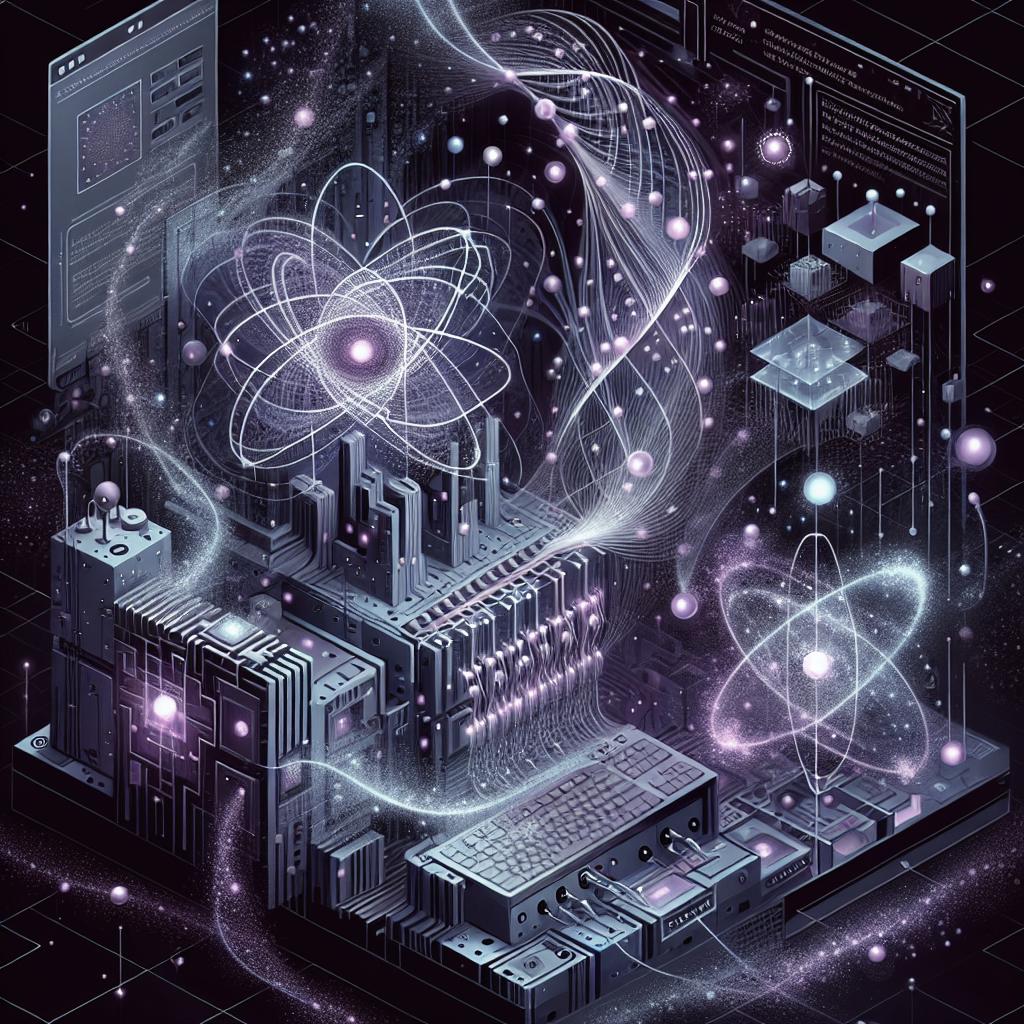
“`html
Basics of Quantum Computing: An Insightful Exploration
Quantum computing is a revolutionary field poised to transform a wide array of sectors through its unique computational abilities that harness the unusual properties of quantum mechanics. Unlike classical computers that use bits, quantum computers employ quantum bits, or qubits. This blog post explores the fundamentals of quantum computing, its distinctive features, potential applications, current limitations, and notable development efforts by major corporations. We will also demystify some common queries about quantum computers, such as their speed, cost, and construction challenges. By understanding these aspects, you’ll gain a comprehensive view of where quantum computing stands today and its prospects for the future.
What Is Quantum Computing?
Quantum computing is a groundbreaking technology that leverages the principles of quantum mechanics to process information. Unlike conventional computers that process data through binary bits (0s and 1s), quantum computers use quantum bits or qubits. These qubits open up new possibilities for computation by utilizing states that are not merely binary.
The basis of quantum computing lies in the ability of qubits to exist simultaneously in multiple states, a property known as superposition. This characteristic enables quantum computers to evaluate numerous possibilities at once, vastly increasing their computational power. Thus, quantum computing holds the potential to solve complex problems that are currently intractable for classical computers.
Understanding Quantum Computing
Key Takeaways
At the core of quantum computing is quantum mechanics, a fundamental theory in physics describing nature at the smallest scales. Quantum computing uses these principles to represent and manipulate data in ways that classical computers cannot.
The main takeaway is that quantum computing operates on completely different paradigms compared to traditional computing, providing opportunities for solving specialized problems with profound implications for fields like cryptography, drug discovery, and financial modeling.
Features of Quantum Computing
Superposition
Superposition is one of the defining features of quantum computing. It allows qubits to exist in multiple states at once, as opposed to classical bits that inhabit a singular state of 0 or 1. This capability empowers quantum computers to process a vast amount of possibilities simultaneously.
With superposition, quantum computers can conduct complex calculations at exponentially faster rates than classical systems, making them particularly useful for tasks involving vast combinatory analyses, such as optimization problems.
Entanglement
Entanglement is another pivotal concept in quantum computing, where qubits become interconnected such that the state of one directly influences the state of another, regardless of distance. This interconnection means that a group of entangled qubits can work in unison to perform operations in ways classical bits cannot.
Leveraging entanglement allows quantum computers to handle tasks demonstrating extreme levels of complexity, enabling breakthroughs in areas like secure communications and complex system simulations.
Decoherence
Decoherence is a challenge unique to quantum computing, representing the loss of quantum behavior as qubits interact with their external environment. Once decoherence occurs, a qubit’s quantum state becomes disrupted, leading to potential errors in computation.
Successfully mitigating decoherence is crucial for building reliable quantum computers. Techniques such as error correction codes and isolation of qubits from environmental disturbance are actively researched to enhance the stability and longevity of qubit states.
Uses and Benefits of Quantum Computing
Quantum computing is poised to revolutionize several industries by solving problems that are currently unsolvable due to classical computers’ limitations. In pharmaceuticals, it holds the potential to simulate molecular structures at an unprecedented level, speeding up drug discovery and development.
Finance, cryptography, and materials design are other sectors that stand to benefit significantly. In finance, quantum computing could enhance risk modeling and portfolio optimization, while in cryptography, it could lead to the development of unbreakable codes. The potential applications seem endless, expanding from fundamental sciences to practical, everyday technology.
Limitations of Quantum Computing
Despite its promise, quantum computing comes with its own set of challenges. One primary limitation is the present inability to maintain and scale qubit systems effectively due to issues like decoherence and noise.
Furthermore, building and maintaining a quantum computing infrastructure requires significant financial investment and technical expertise. These hurdles reveal that while the technology’s potential is vast, practical and scalable implementations are still primarily in the developmental stage.
Quantum Computer vs. Classical Computer
The fundamental distinction between quantum and classical computers is their mechanism of data processing. Classical computers rely on bits, whereas quantum computers utilize qubits, allowing them to explore multiple computational paths simultaneously.
This difference illustrates why quantum computers, despite being in their infancy, offer the potential to tackle specific problems much faster and with greater efficiency than today’s fastest supercomputers. Nevertheless, classical computers remain essential for routine computing tasks and are not expected to be fully replaced by quantum computers anytime soon.
Challenges and Opportunities
Quantum computing presents both challenges and opportunities. Building a full-scale quantum computer requires overcoming significant technical barriers related to qubit stability, error mitigation, and hardware requirements.
However, the opportunities are equally promising. Quantum computing has the potential to transform industries, enabling breakthroughs in science, technology, and societal problems currently constrained by the limits of classical computing.
What Is Quantum Computing in Simplest Terms?
In the simplest terms, quantum computing is a form of computing that utilizes the principles of quantum mechanics to perform calculations far beyond the capabilities of today’s classical computers. It represents an evolution in computing technology that may redefine what is feasible in terms of information processing.
For the layperson, it is helpful to think of quantum computing as akin to a massively parallel processing engine with the potential to revolutionize problem-solving across multiple domains.
How Hard Is It to Build a Quantum Computer?
Building a quantum computer is extraordinarily challenging due to the inherent sensitivity of quantum states. Qubits require very low temperatures and isolated environments to maintain coherence, making them delicate and complex to manage.
Additionally, scalable quantum computing systems demand advanced materials, innovative design, and complex error correction techniques, all of which are areas of intense research and development across academic and industrial settings.
How Much Does a Quantum Computer Cost?
The cost of building a quantum computer can be astronomical, ranging from several million to potentially billions of dollars, depending on the sophistication and capability of the machine. The costs stem from the need for cutting-edge technology, extensive research and development, and the infrastructure required to maintain operational stability.
As the technology matures, it is anticipated that costs will decrease, making quantum computing more accessible to a broader range of industries and potentially spurring a shift in computing economics.
How Fast Is a Quantum Computer?
The speed of a quantum computer is determined by its ability to perform specific types of calculations exponentially faster than classical counterparts. Due to its parallel processing capabilities enabled by superposition and entanglement, a quantum computer can solve certain complex problems in minutes that would take classical computers millennia.
It is crucial to note, however, that not all computational tasks can leverage quantum speedup. Quantum computers excel in specific domains, and their speed must be understood in the context of those unique problem-solving capabilities.
Quantum Computers In Development
Google has been at the forefront of quantum computing research. Their development of the Sycamore processor achieved the milestone of quantum supremacy by solving a complex problem faster than a classical supercomputer could.
Google’s efforts continue as they aim to develop more stable and scalable quantum systems that can tackle real-world applications beyond laboratory environments.
IBM
IBM has made significant strides with their Quantum Experience platform, enabling developer access to cloud-based quantum computing experiments. IBM is working on reducing errors and increasing the reliability of qubit operations to make quantum computing more viable for practical use.
Their roadmap involves building progressively larger and more powerful quantum processors, with a goal to integrate quantum computing into mainstream computing tasks.
Microsoft
Microsoft is investing in robust quantum computing solutions and focusing on topological qubits to enhance stability. Their Quantum Development Kit and Azure Quantum platform open up quantum solutions for developers and businesses.
Through strategic partnerships and continued research, Microsoft is exploring the boundaries of scalable quantum computing to integrate the technology into existing digital frameworks.
Others
Numerous other companies and academic institutions, such as Rigetti Computing, D-Wave Systems, and universities worldwide, are also heavily involved in quantum computing research and development. These entities bring diverse approaches, such as using different qubit technologies or algorithms, to advance the field.
The collective efforts of these organizations contribute to the dynamic growth and innovation seen in quantum computing, fostering a collaborative environment that accelerates progress towards practical applications.
The Bottom Line.
| Aspect | Details |
|---|---|
| What Is Quantum Computing? | A form of computing using quantum mechanics to perform highly complex calculations efficiently. |
| Features | Superposition, entanglement, decoherence. |
| Uses and Benefits | Enhanced computational power for fields like cryptography, pharmaceuticals, and optimization problems. |
| Limitations | Scalability challenges, high operational costs, and technical complexity. |
| Quantum vs. Classical | Quantum offers unique parallel computation capabilities but is currently limited in practical use cases. |
| Current Developments | Efforts by companies like Google, IBM, Microsoft, and others focusing on scalability and real-world applications. |
“`