
“`html
Introduction
In today’s digital era, technology continues to evolve and transform the way we interact with the world around us. At the forefront of this transformation is computer vision, a groundbreaking field of artificial intelligence that enables machines to interpret and make decisions based on visual data. From healthcare to automotive industries, computer vision applications are vast and influential, reshaping numerous sectors by providing machines the ability to emulate human vision at an unprecedented scale. This blog post delves into the workings, history, advancements, and diverse applications of computer vision, alongside examining its challenges and future prospects. We’ll also discuss data labeling’s significance in the domain, highlighting solutions offered by Kili Technology.
What is Computer Vision?
Computer vision is a field of computer science dedicated to enabling machines to process, analyze, and understand visual data from the world, in part by replicating the complex and comprehensive capabilities of human vision. Unlike traditional image processing, which involves manipulating an image for filtering or rendering, computer vision seeks to answer deeper questions: What does this image mean? What information can be extracted from its visual elements?
This powerful technology uses algorithms to interpret and extract insights from digital images and video content, allowing computers to understand and make sense of visual input. Advances in deep learning and neural networks have been foundational to computer vision, fostering its ability to perform complex tasks such as identifying patterns, detecting objects, and understanding environments.
How does Computer Vision Work?
Computer vision operates by using sophisticated algorithms to transform visual data into formats machines can understand and process. This begins with image acquisition, where images are captured from cameras or sensors. Next is preprocessing, involving adjustments for better clarity or noise reduction, which are crucial for accurate analysis.
The core component is feature extraction, where identifying key structures or patterns within the image occurs. Machine learning models, especially convolutional neural networks (CNNs), play a significant role in this step, learning to recognize patterns from vast datasets. Finally, a system feeds trained data into decision-making algorithms, allowing computers to draw conclusions about the image content, similar to how human brains decode visual information.
Why is Computer Vision Difficult?
The complexity of computer vision arises from the inherent intricacy of visual perception. Human vision benefits from millions of years of evolution, which computer algorithms must hastily replicate. Additionally, visual information is varied; variations in lighting, angles, occlusion, and background noise make consistent interpretation challenging.
Another difficulty lies in teaching machines to understand context—something humans excel at naturally. Bridging the gap between simply recognizing objects and understanding their interrelationships and the scene around them is a major hurdle. The compute power needed for training precise networks is also formidable, underscoring the challenges in replicating human-like visual comprehension.[
Computer Vision History and Research
Computer vision’s origins trace back to the 1960s, when researchers first began exploring the possibility of digital image processing. Early work focused on simple algorithms to recognize geometric shapes and patterns. Over the ensuing decades, increased computational power and more sophisticated algorithms allowed progress from basic recognition tasks to intricate image analysis.
With the development of machine learning from the 1990s onward, the field saw tremendous growth. The introduction of neural networks and, later, deep learning, transformed computer vision, enabling automated systems to understand complex visual information in ways previously beyond reach. Today, research continues to push boundaries, focusing on real-time visual processing, 3D scene reconstruction, and enhanced accuracy in object recognition.
Computer Vision Applications
Computer vision technology is imperative in a broad range of applications that impact daily life and business operations. One of its primary uses is in digital image classification, where machines categorize images into predefined classes. This capability is commonly utilized in content management, social media, and various digital platforms to organize, filter, and tag image content efficiently.
Digital Image Classification
Digital image classification allows machines to discern and label an image based on its content, identifying objects, scenes, or activities. Businesses leverage this for enhanced user experience, enabling search engines or online services to organize visual data seamlessly. It’s monumental in fields like e-commerce, where categorizing products based on visuals is crucial.
Digital Object Detection
Object detection is a more granular application within computer vision, focusing on identifying specific items inside an image and classifying them by label. This involves recognizing multiple objects in different sizes and iterations, often concurrently. It’s empowered advancements in autonomy, including automotive safety systems and surveillance.
Digital Image Segmentation
Digital image segmentation involves partitioning an image into segments to simplify its complexity and make it more analyzable. Each segment represents an object category. Segmentation plays a critical role in medical imaging, enabling doctors to single out and assess particular structures or abnormalities in diagnostic tools.
Advancements in Computer Vision
Computer vision has rapidly advanced alongside innovations in data processing capabilities and artificial intelligence algorithms. Key developments include improved accuracy and speed in recognition systems, and the ability to analyze 3D scenes and generate lifelike reconstructions. Cloud-based vision services are also making sophisticated computer vision techniques accessible to businesses globally.
Autonomous systems, from driverless cars to robotics, demonstrate the application of cutting-edge computer vision, processing visual data in real-time for environment navigation and interaction. Furthermore, advancements in neural network architectures like transformers hint at the next generation of image analysis, leaning sharply on increased resolution and perspective accuracy.
Computer Vision Examples
Face and Person Recognition
Face and person recognition are among the most prevalent examples of computer vision applications, widely implemented in security systems, user verification processes, and personalized marketing. By identifying and analyzing facial features, algorithms can determine an individual’s identity swiftly and securely.
Edge Detection
Edge detection involves identifying the boundaries within images, allowing for easier interpretation of shapes and structures within the visual content. It is essential in image analysis, especially for computer graphics and vision systems that require structure simplification for efficient processing or sketch-based modeling.
Digital Image Restoration
Digital image restoration employs computer vision to repair and enhance old or damaged images, optimizing them for clarity and precision. Key in the media industry, this technique allows historically significant pictures or early cinematography to be preserved and appreciated despite the limitations of their original formats.
Digital Scene Reconstruction
Digital scene reconstruction employs computer vision methods to develop 3D models of physical spaces, effectively capturing and recreating real-world environments in digital form. This finds application in gaming, virtual reality, and urban planning, providing rich, immersive experiences or comprehensive spatial data.
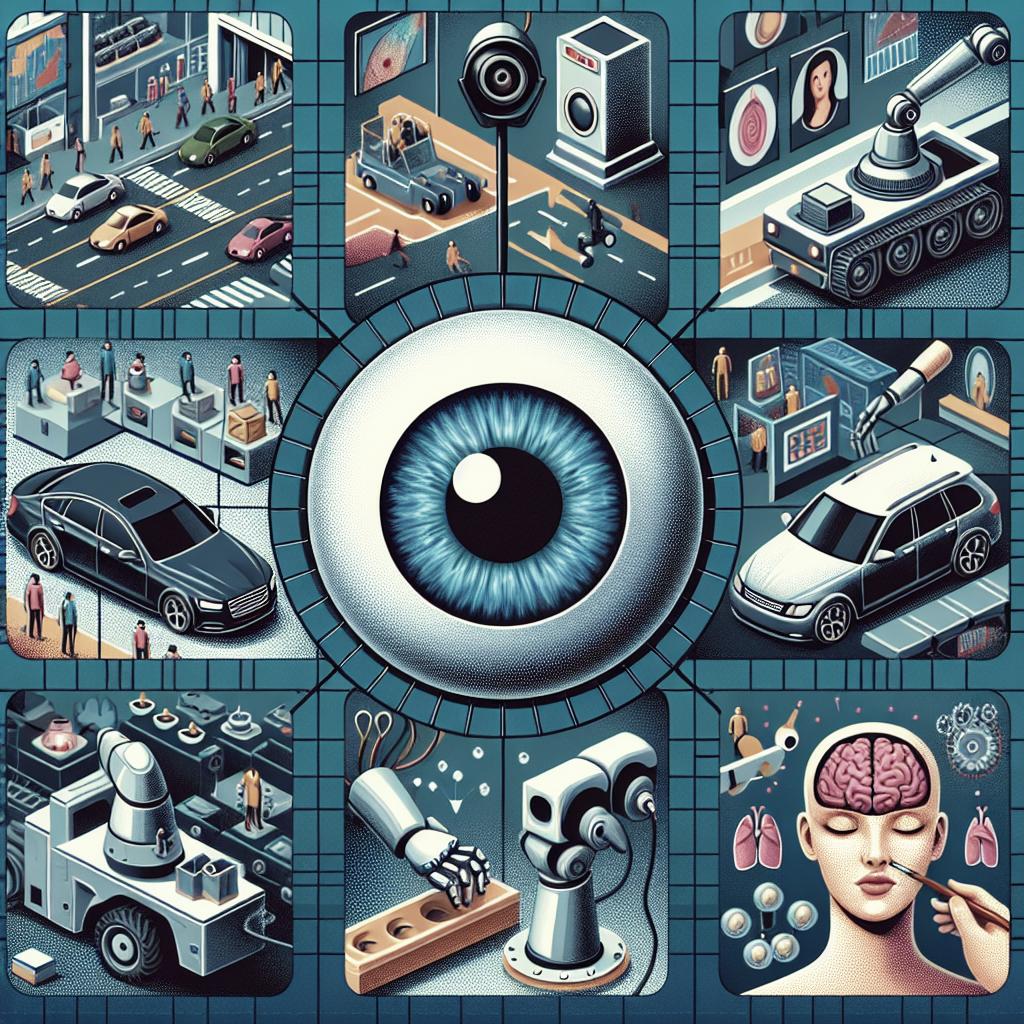
Computer Vision Technology Applied
The Challenges Computer Vision Currently Faces
Despite impressive advancements, computer vision continues to confront several challenges. Chief among these is the task of improving accuracy and robustness in diverse operating conditions, a requisite for dependable autonomous systems.[from h3 challenges paragraph]
Generic Challenges
Generic challenges include the computational power needed to process high volumes of data and the difficulty in achieving consistent accuracy across varied environments. Improvements in energy efficiency and processing capabilities are crucial for the evolution of real-time applications.[general problems moved from Difficult h3]
Scene Comprehension Challenges
Scene comprehension remains challenging due to the need for deep contextual understanding within images. Machines don’t naturally grasp the same subtleties humans do, making it difficult to infer intent or meaning beyond raw visual data.[the par from difficulties h3 challenges]
Privacy Issue Challenges
Privacy is an increasingly significant issue as computer vision proliferation raises concern around data misuse and unauthorized surveillance. Balancing progress with the assurance of ethical data handling is essential for public trust and business integrity.
Next Steps
| Aspect | Details |
|---|---|
| Definition | Computer vision is a field enabling computers to interpret and make decisions based on visual data using AI algorithms. |
| Working Process | The process involves image acquisition, preprocessing, feature extraction, and decision-making using machine learning models. |
| Applications | Used in digital image classification, object detection, and image segmentation across various industries. |
| Examples | Includes face recognition, edge detection, image restoration, and scene reconstruction tasks. |
| Challenges | Generic computational demands, scene comprehension, and privacy issues. |
FAQ
What is the Role of Data Labeling in Computer Vision?
Data labeling is integral to computer vision, providing annotated datasets necessary for training models. Labeled data enables algorithms to recognize and categorize visual information accurately by offering explicit examples from which to learn.
What are the Common Data Labeling Tasks in Computer Vision?
Common tasks include bounding boxes for object detection, semantic segmentation where each pixel is assigned a label, and keypoint annotation for identifying specific locations within an image, essential for applications like facial recognition and pose estimation.
How Does Kili Technology Assist in Data Labeling for Computer Vision?
Kili Technology supports data labeling through its robust platform offering tools that streamline the annotation process, improve accuracy, and reduce time. Their platform leverages automated workflows, insightful analytics, and collaborative features to enhance labeling efficiency and effectiveness.
What are the Challenges in Data Labeling for Computer Vision?
Challenges include ensuring consistency and accuracy across large datasets, tackling complex labels that require domain-specific knowledge, and managing the time and resources necessary for meticulous annotation.
“`