
“`html
Understanding the Principles of Object-Oriented Programming
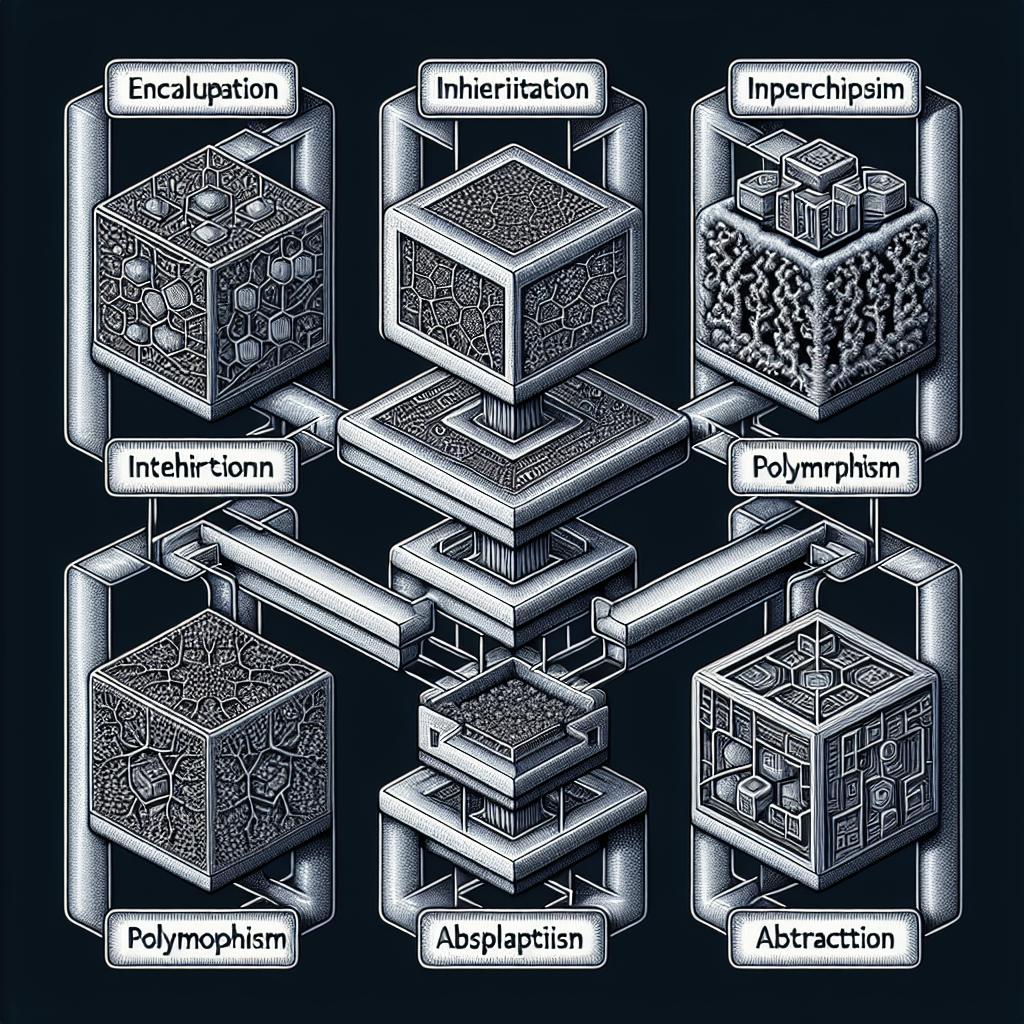
Object-oriented programming (OOP) is a paradigm that uses objects to model real-world phenomena, making it a popular choice in software development. The core principles of OOP—encapsulation, abstraction, inheritance, and polymorphism—help developers create modular, scalable, and maintainable code. Each principle offers distinct advantages and methodologies that contribute to the overall efficiency and effectiveness of programming. In this blog post, we’ll delve into these fundamental principles of OOP, explore their significance, and help you understand how they can be applied in the development process. By the end of this reading, you’ll have a solid foundation in OOP, guiding you in structuring your code base effectively.
Encapsulation
Encapsulation is the concept of bundling the data and the methods that operate on that data within a single unit, typically a class. It restricts direct access to some of the object’s components, which is a means of preventing unintended interference and misuse of the data. In practical terms, encapsulation provides the protective barrier needed to achieve data hiding, ensuring that the internal representation of an object is shielded from the outside interference and misuse.
By using getters and setters, encapsulation offers controlled access to an object’s data. This practice not only enhances data security but also improves the flexibility of the code. Developers can change internal implementations without affecting the parts of the code that rely on the public interface. This results in a more modular code structure which is easier to maintain and extend over time.
Overall, encapsulation is crucial in fostering a robust program architecture. It allows developers to group related tasks into a single entity, simplifying code navigation and understanding while enhancing data integrity and security. As a practice, it encourages writing clean, manageable, and error-resistant codebases, which are essential qualities in any software development project.
Abstraction
Abstraction, a complementary concept to encapsulation, is about simplifying complex systems by modeling classes based on the essential properties and behaviors they must exhibit. Through abstraction, a programmer can focus on relevant attributes and behavior, ignoring the irrelevant details, which facilitates the development of cleaner and more focused code.
In OOP, abstraction is achieved through abstract classes and interfaces. Abstract classes cannot be instantiated on their own and often contain both abstract methods with no implementation and concrete methods with implementations. Interfaces, on the other hand, define method signatures without any implementation, serving as blueprints for classes that implement them. This allows for a contract-driven development approach where different classes can have diverse implementations but share common behaviors through their interfaces.
Leveraging abstraction optimizes code reusability and enhances system modularity, paving the way for scalable and efficient code architecture. It aids in more manageable and understandable code by reducing complexity, enabling developers to tackle larger problems with a more comprehensive approach.
Inheritance
Inheritance is one of the cornerstones of OOP, enabling new classes to inherit properties and methods from existing ones. This principle promotes code reusability and establishes a natural hierarchy, which can be particularly beneficial when scaling software projects. It forms a parent-child relationship that allows for easy extension and alteration of base classes.
With inheritance, changes made to a parent class automatically propagate to all child classes, reducing redundancy and increasing efficiency in code management. This not only helps in organizing code logically but also aids in eliminating duplication, thereby making the application easier to manage and update.
Despite its benefits, inheritance can introduce complexity if misused or overused. Developers are encouraged to understand when it is appropriate to use inheritance rather than creating new, unrelated classes. A thoughtful application can enhance productivity and offer elegant solutions to complex problems.
Polymorphism
Polymorphism allows methods to do different things based on the object it is acting upon, even though they share the same interface. This principle means ‘many forms’, and it empowers developers to design interfaces with the flexibility for different underlying implementations.
There are two main types of polymorphism in OOP: compile-time (overloading) and runtime (overriding) polymorphism. Method overloading allows different methods to have the same name with different signatures within the same class. Method overriding allows a child class to provide a specific implementation of a method that is already defined in its parent class.
Polymorphism is a powerful tool for achieving dynamic behavior in programming, contributing significantly to the flexibility and maintainability of the code. It enhances the ability to manage change by allowing new functionalities to be added with minimal impact on the existing code base.
What’s next?
Understanding and applying the principles of object-oriented programming is a significant step towards mastering modern programming. These principles support the creation of software that is modular, flexible, and scalable. However, OOP is ever-evolving, and as a programmer, it’s essential to stay abreast of new languages, tools, and methodologies that incorporate and expand upon these foundational concepts.
As technology continues to advance, the future steps involve integrating OOP with other paradigms, such as functional programming, to leverage their combined strengths. Developers should constantly seek to improve and refine their skills, ensuring they remain informed about industry trends and development best practices. Engaging with community forums, following industry experts, and experimenting with new technologies can catalyze further growth and innovation in this field.
The journey through object-oriented programming is just beginning. By adopting its principles, you can harness the power of organized, reusable, and adaptable code, setting the stage for successful and sustainable software projects.
| Principle | Key Benefits | Implementation Strategies |
|---|---|---|
| Encapsulation | Data security and modularity | Use of getters and setters |
| Abstraction | Code reusability and reduced complexity | Abstract classes and interfaces |
| Inheritance | Code efficiency and natural hierarchy | Parent-child class relationships |
| Polymorphism | Dynamic behavior and flexibility | Method overloading and overriding |
“`